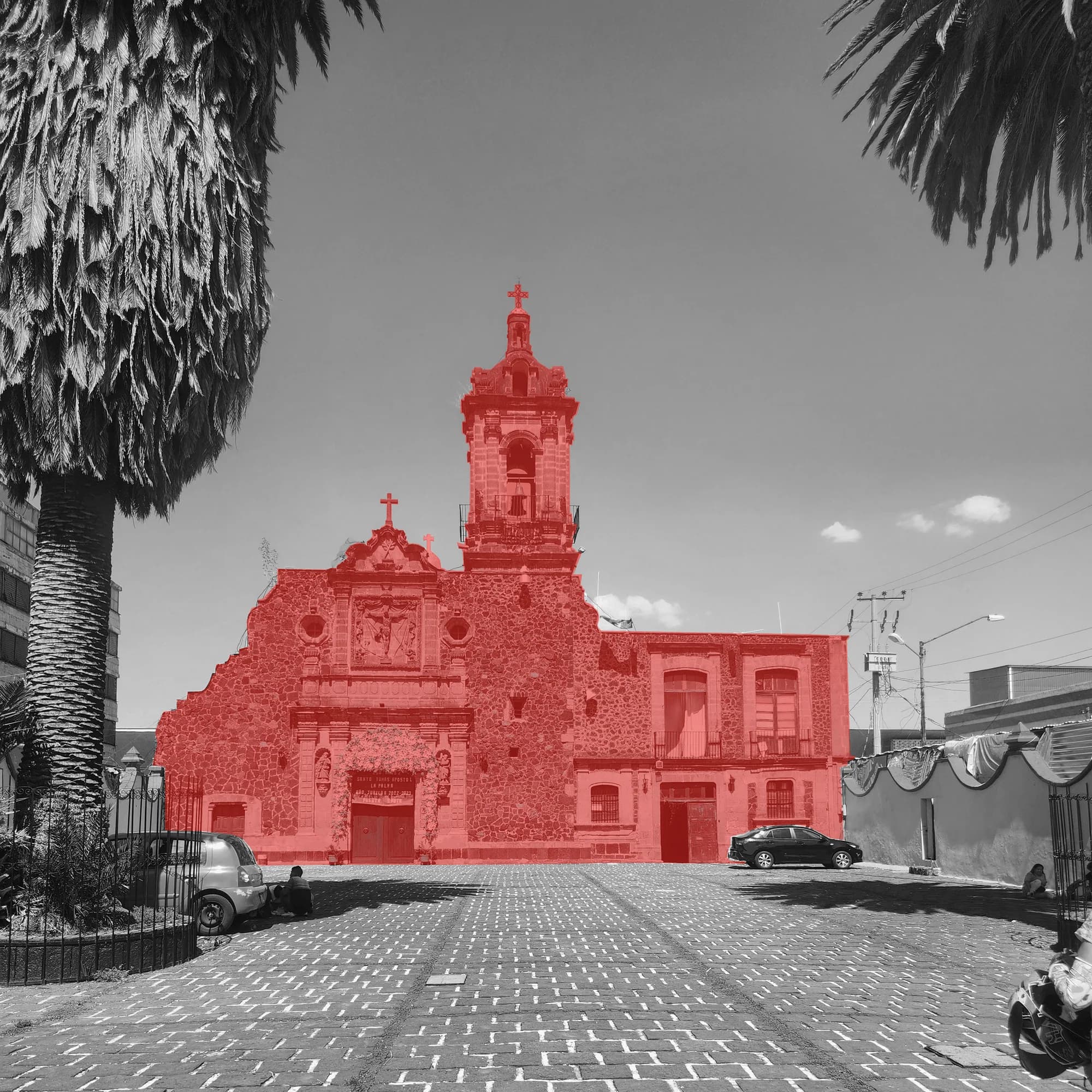
A reading of Santo Tomás Apóstol La Palma church and the commercial layer that displaced its public presence along Circunvalación.
1A building that was not hidden
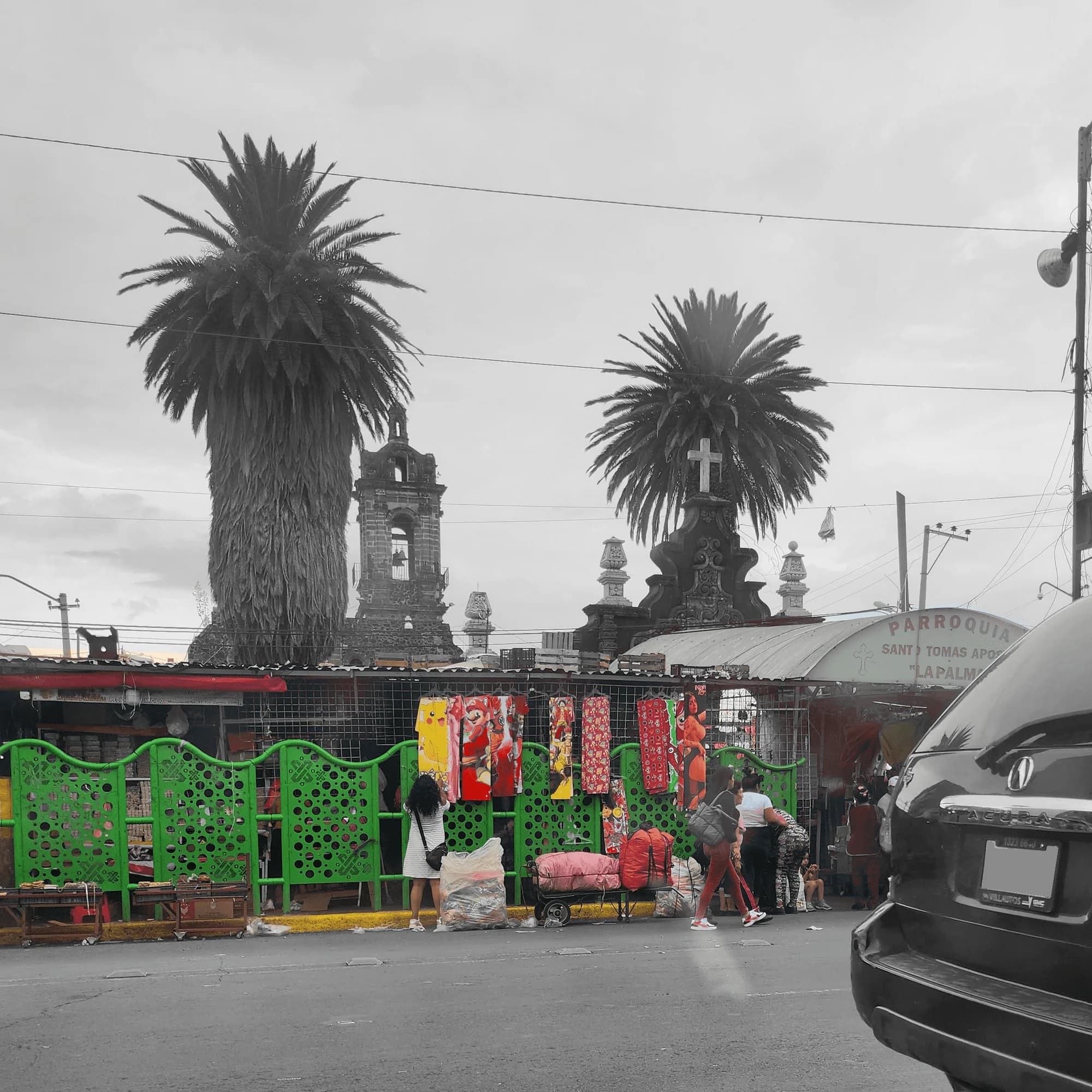
For years I drove along Circunvalación almost every day. I am an architect; looking at buildings is quite literally the job. Yet I never saw Santo Tomás Apóstol La Palma church.
It was not boarded up, ruined, or concealed behind another building. It stood exactly where it stands today, with its two palms rising above the avenue.
When I finally saw it—and _finally_ is the right word, because the discovery was late and slightly embarrassing—my first thought was not _how beautiful_. It was _how is this possible?_
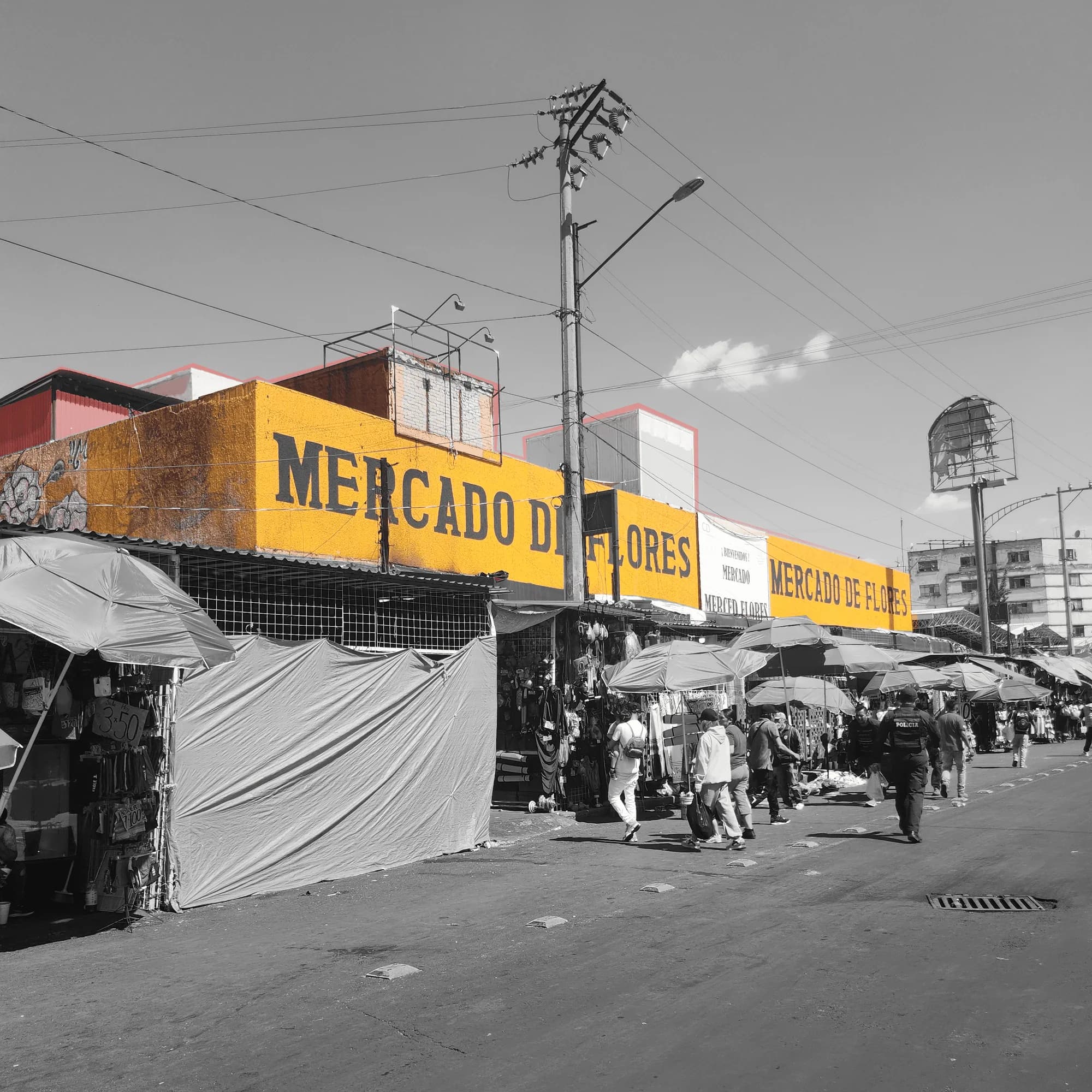
There are easy explanations. The loud orange Mercado de las Flores captures the eye from the first day. Circunvalación traffic forces attention onto the road. But that does not explain why, once seen, the church appeared obvious. A building does not disappear because passersby are distracted. It disappears when something else occupies its place in the visual field and performs its work better.
FIG. 03
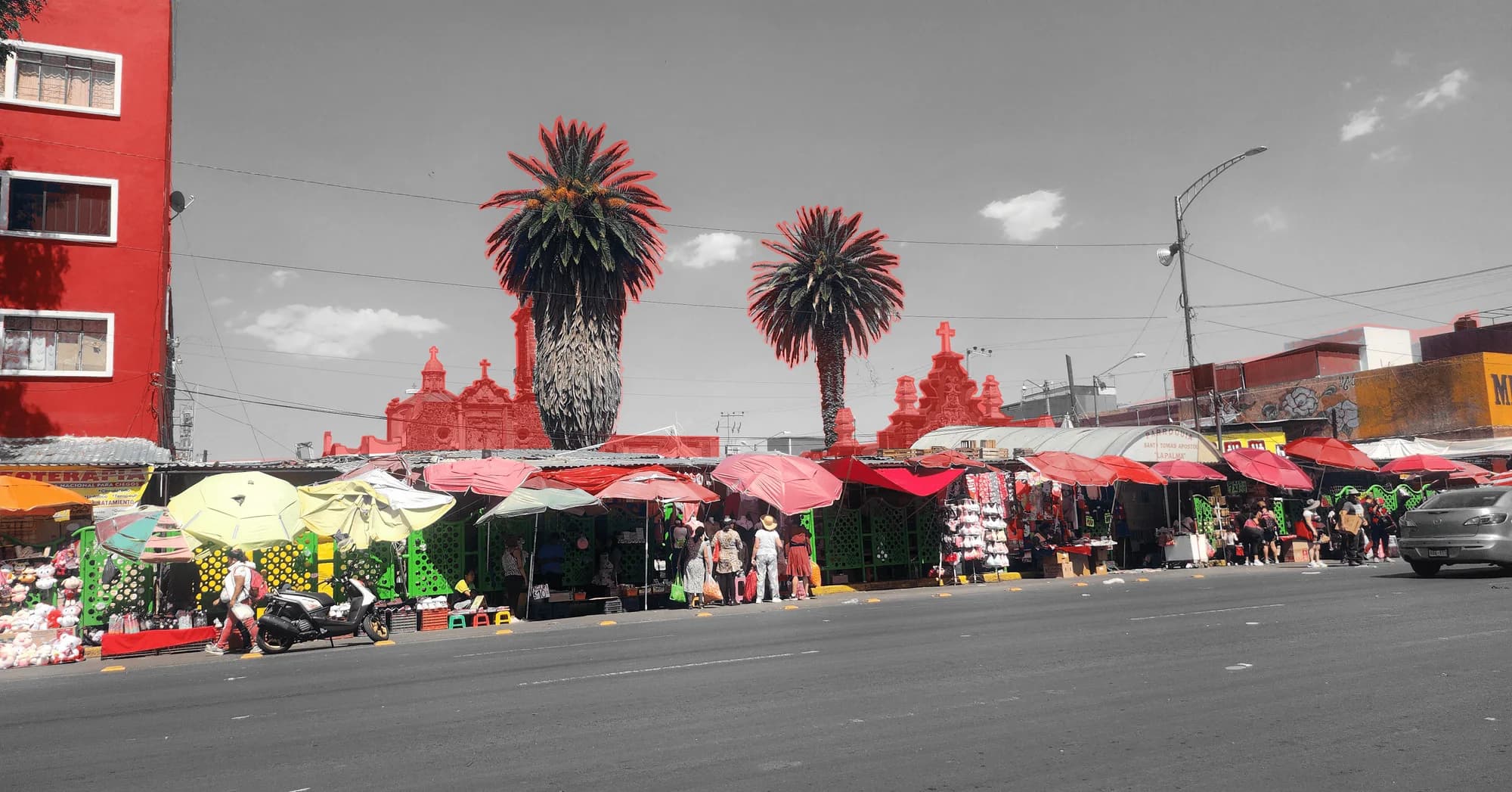
FIG. 02
2Giving it a name
I call the aesthetics of appropriation the visible result of a process in which a built space is occupied, covered, and reinterpreted by uses foreign to its original design, until the public reading of the building no longer corresponds to the building itself.
Four conditions seem essential. There must be a prior architecture with a legible identity. An unforeseen use must accumulate over it. That accumulation must replace—not merely accompany—the public reading of the building. And no one must have designed the final whole.
The last condition holds the others together. Without it, this would be scenery, intervention, or advertising.
It is not adaptation, because adaptation negotiates with the building. It is not reuse, because reuse enters it. It is not decay: nothing is missing here; there is too much. It is not collage, because collage has an author and a frame. Nor is it cultural appropriation, which asks who has the right to use a symbol. Here nobody argues. Things are simply hung.
La Palma is where I found the term. It is not the only place where the term works.
3The buffer zone
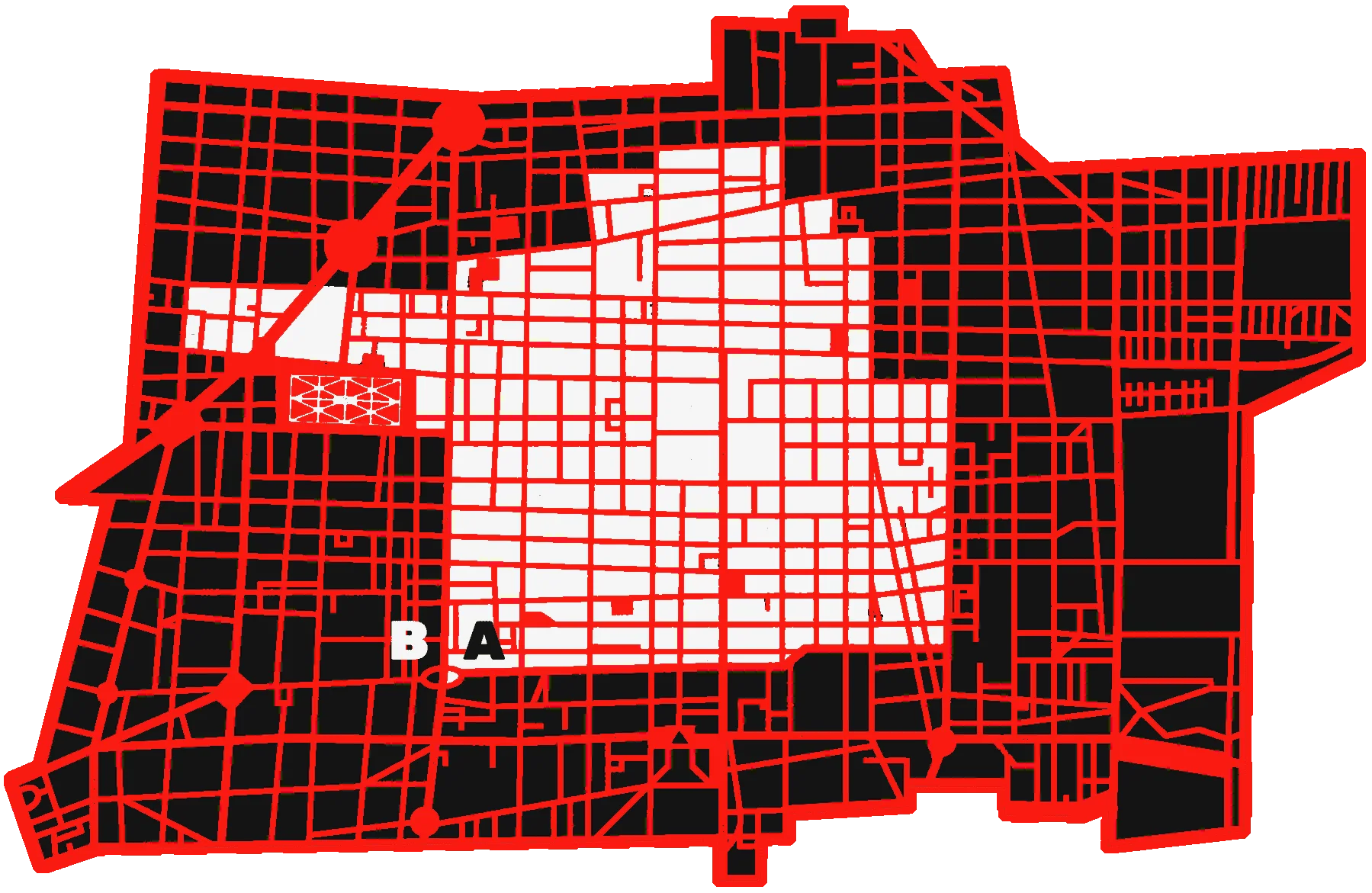
The Historic Center of Mexico City entered the World Heritage List with Xochimilco on December 11, 1987. It is divided into two perimeters. Area A holds most of the valued buildings within 2.7 square kilometers. Area B surrounds it with 7.31 square kilometers and more than six thousand buildings. In the official planning instrument, Area B is called the _buffer zone_.
That phrase deserves attention. A buffer absorbs an impact so it does not reach the other side. For decades, the church has stood inside the strip that the city designated, in writing, to receive it.
La Palma lies in Area B, directly beside the edge of Area A. Circunvalación—the avenue I traveled—is the line between them.
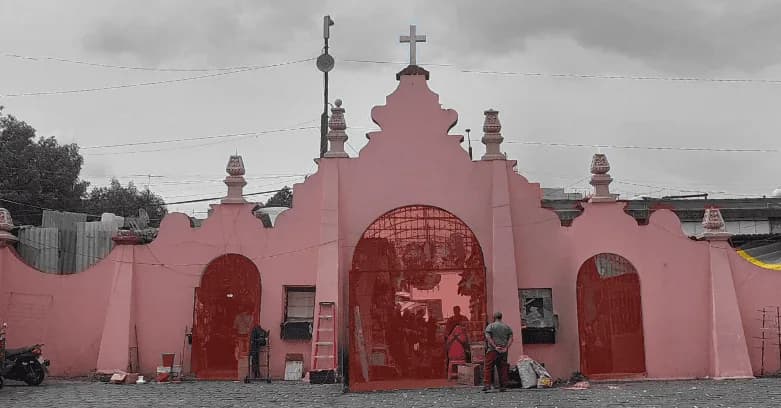
Little is known about the building, and what is known is eloquent. The Augustinians probably established it in the sixteenth century as an adobe hermitage in the Indigenous neighborhood of Zoquiapan, at the site called Ayauhcalco: the house of mists. Construction of the present church began in 1728. It served as a chapel of Santa Cruz y Soledad until the secularization of the parishes gave it its own priest in 1772. In the nineteenth century its vault was rebuilt, and its atrium, inverted-arch walls, and portico were added. In other words, the nineteenth century added precisely the walls that now support commerce.
It changed religious order, jurisdiction, name, and neighborhood. La Palma has experience becoming something else. What is new is not that it changed, but that this time no single person changed it.
FIG. 05
FIG. 06
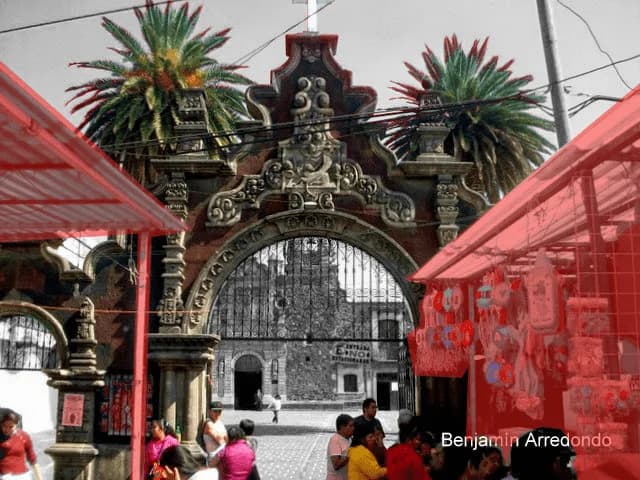
The sequence can be assembled without leaving a computer: Street View in May 2009, Benjamín Arredondo's March 2014 photograph already describing the church as _oppressed_, and my photographs from 2023. In sequence, they do not show a building deteriorating. They show a building being covered.
FIG. 08
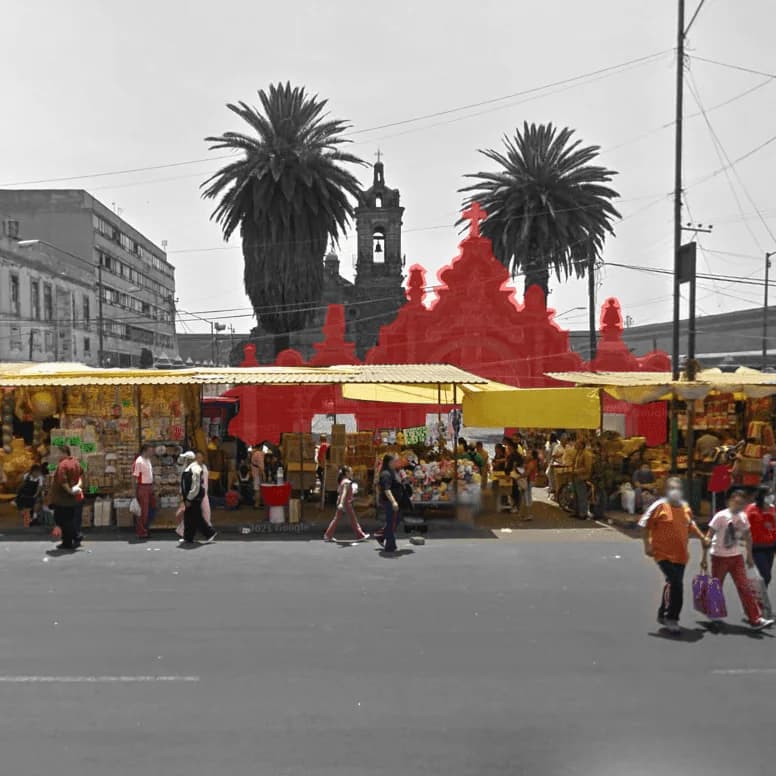
FIG. 09
4The burladero
In June 2019, Mexico City's government began installing metal structures along Anillo de Circunvalación in La Merced, working with the Venustiano Carranza and Cuauhtémoc boroughs. The stated target was 3,120 structures across twenty blocks, from Fray Servando to Eje 1 Norte, beginning with the relocation of 850 stalls. The official objectives were traffic and pedestrian mobility, public safety, and urban image.
They called the structures _burladeros_.
In bullfighting, a burladero is the screen behind which the bullfighter shelters from the bull. The word already contained the premise: someone will outmaneuver someone else. Nobody asked who.
The measure partly worked. Almost no commerce remains in the roadway. But on the pavement, the burladero did something absent from the official bulletin: it solved the most expensive problem of an informal stall—the wall.
A stall needs a face toward the street: something firm, continuous, and at body height on which to hang goods and against which to lean. The government installed 3,120 such faces, made of steel, aligned, and free. The merchant only had to supply the interior partitions, roof, and tarpaulin. The rest was already there.
The barrier became structure. Containment became façade.
One detail is especially telling: the city government's logo is printed on the burladero. The emblem of the authority that installed the barrier is now part of the merchandise display, among the towels.
FIG. 11
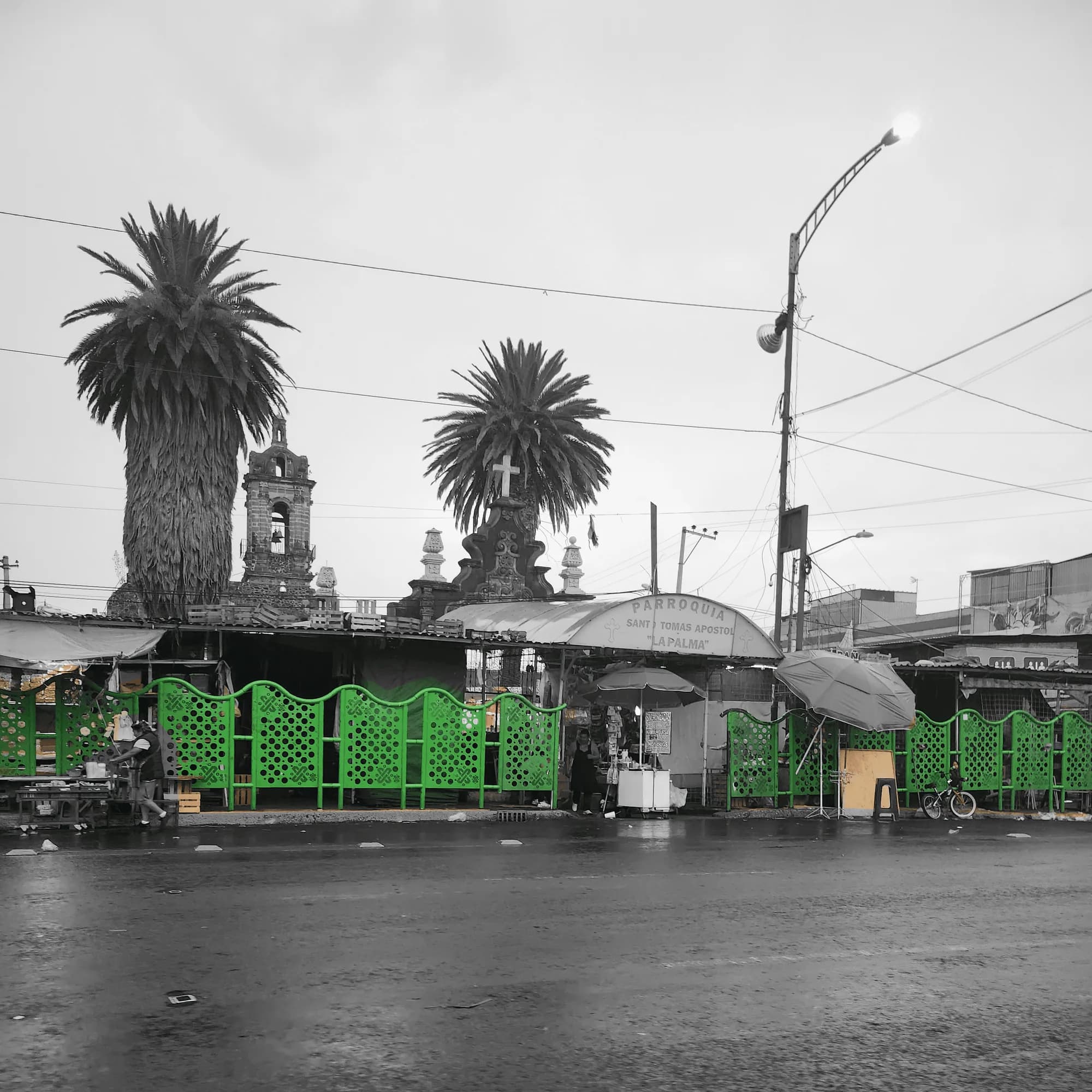
FIG. 18
5The façade that won
Umberto Eco discussed architecture as mass communication and observed that most architectural objects were not made to communicate, but to function.
La Palma's façade is an exception. It was built to communicate. A relief of Christ on the cross is framed by a curtain held by angels: an eighteenth-century mass-communication device, with iconography, hierarchy, and an audience.
It lost to a fluorescent poster board.
Not because it was ugly or old. It lost because the poster is closer, lower, changes every day, and states a price.
Venturi and Scott Brown went to Las Vegas to learn from a landscape made for the car and returned with a distinction that still matters: the decorated shed, a generic building onto which a sign is hung to carry the symbolic work. La Palma is a decorated shed with two differences. The shed is not generic; it is an eighteenth-century church. And the sign was not designed for it. It arrived three centuries later, from another economy, with other customers and other gods.
Las Vegas requires a journey. I found La Palma as they found their subject: from a car, at the speed of an avenue. The difference is that the landscape worked so well on me that it erased the building.
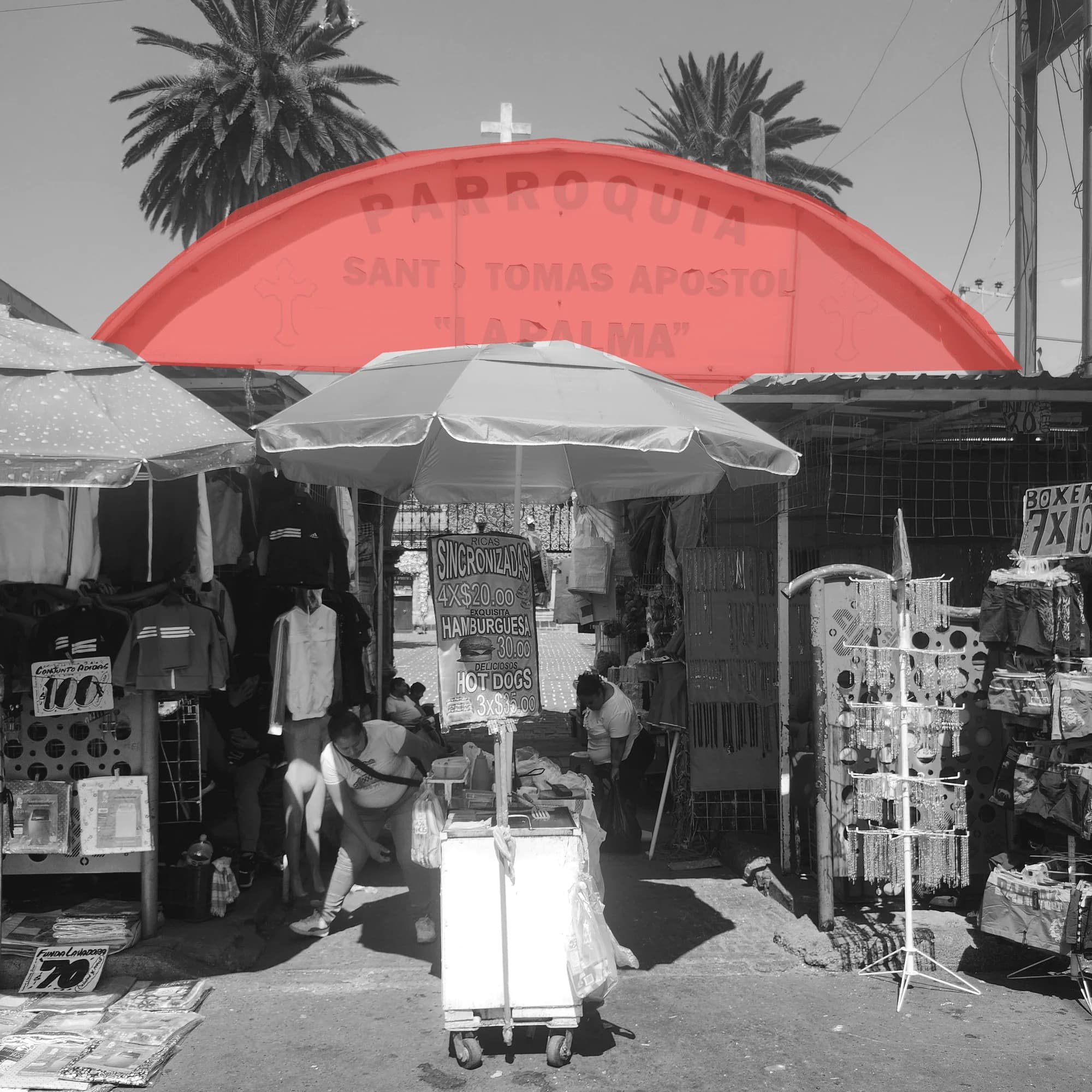
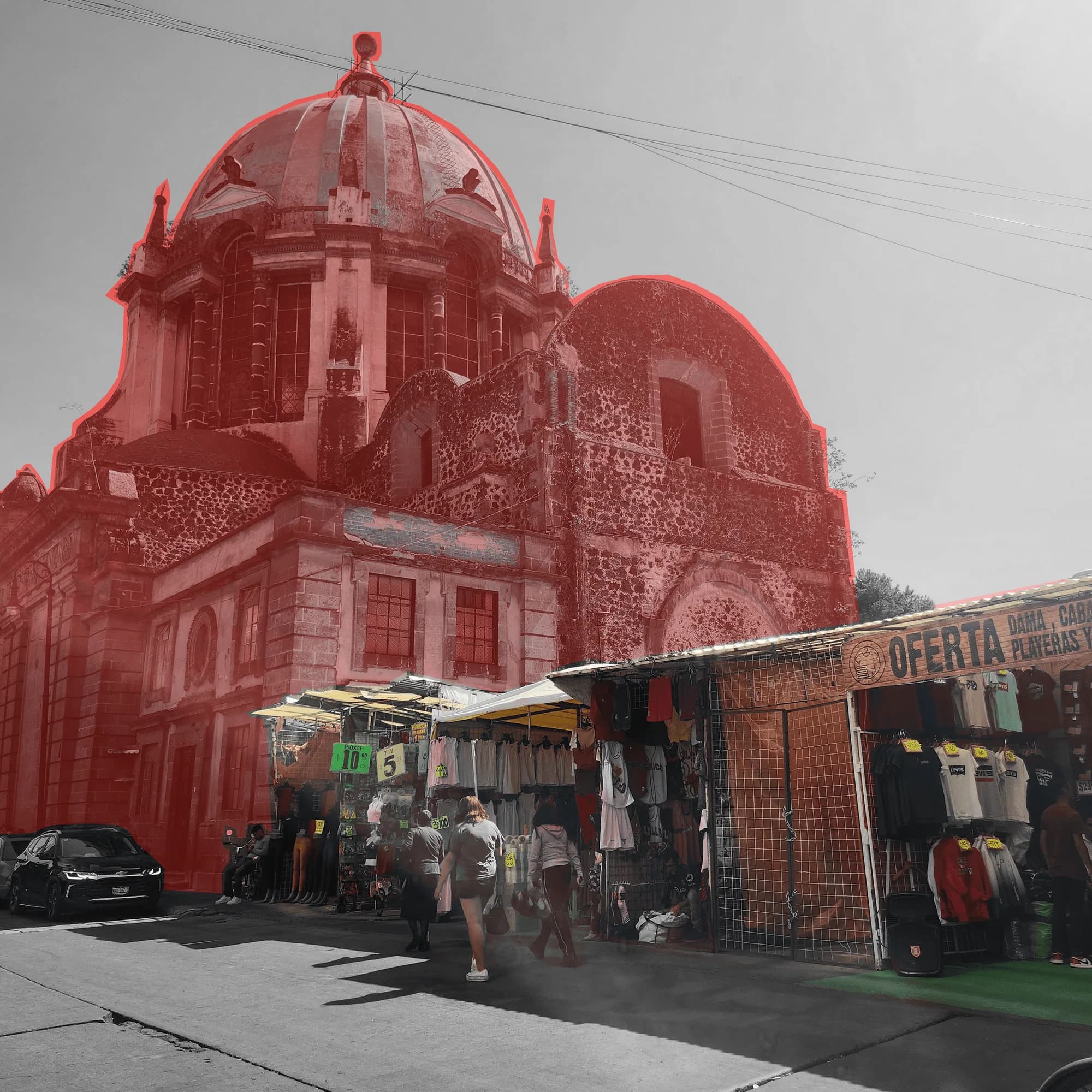
What hangs there has a catalog, and I wrote it down: a Lightning McQueen bag; Barbie bunting; Minions and Cinderella lunchboxes; an Elsa market bag; Bulls shirts; clothes marked Levi's and Adidas; towels printed with nude models; fluorescent price signs in impossible lettering; hand-painted signs; and a menu for sincronizadas, hamburgers, and hot dogs at the entrance to the portico.
Almost all of it is counterfeit, and that produces a final twist. A Bulls shirt bought on Circunvalación is an object that appropriated a brand, hanging from a stall that appropriated a wall, on a building whose symbolic ownership the avenue reassigned. Appropriation within appropriation: meta-appropriation. Counterfeiting is not the essential condition. What matters is that the material of the new façade is itself made from borrowed identities.
None of this is a style. It is what happens when a hundred small decisions, made by people who do not know one another and are not thinking about architecture, end up producing a façade.
FIG. 04
6Denial by addition
Shane Reiner-Roth proposed the term _denial aesthetics_ for objects that deny their own nature in order to communicate a value greater and cheaper than themselves. His examples tend toward thinness: things designed to become invisible.
At La Palma the denial moves in the opposite direction. Nothing becomes thinner; everything thickens. The façade is not denied by transparency but buried beneath objects. Denial by addition.
It is not entirely unconscious, although it is not a plan. The merchant knows a wall is being covered because it is needed to tie the tarpaulin. What nobody decided was to erase a church from the avenue. That result emerged on its own, like wear on a stair.
Pallasmaa argues that modern architecture privileges the eye and leaves the other senses hungry. La Palma presents the opposite problem, solved by no architect. Every sense is active at once: jokes pour from a speaker, traffic fills the avenue, food mixes with the scent of the flower market, and the iron of the burladero has to be touched in order to pass.
One must pass. Between the burladero and the façade remains a corridor only one body wide. Appropriation changed more than what can be seen; it changed the threshold, the route, and the speed of arrival. One enters mass sideways.
FIG. 20
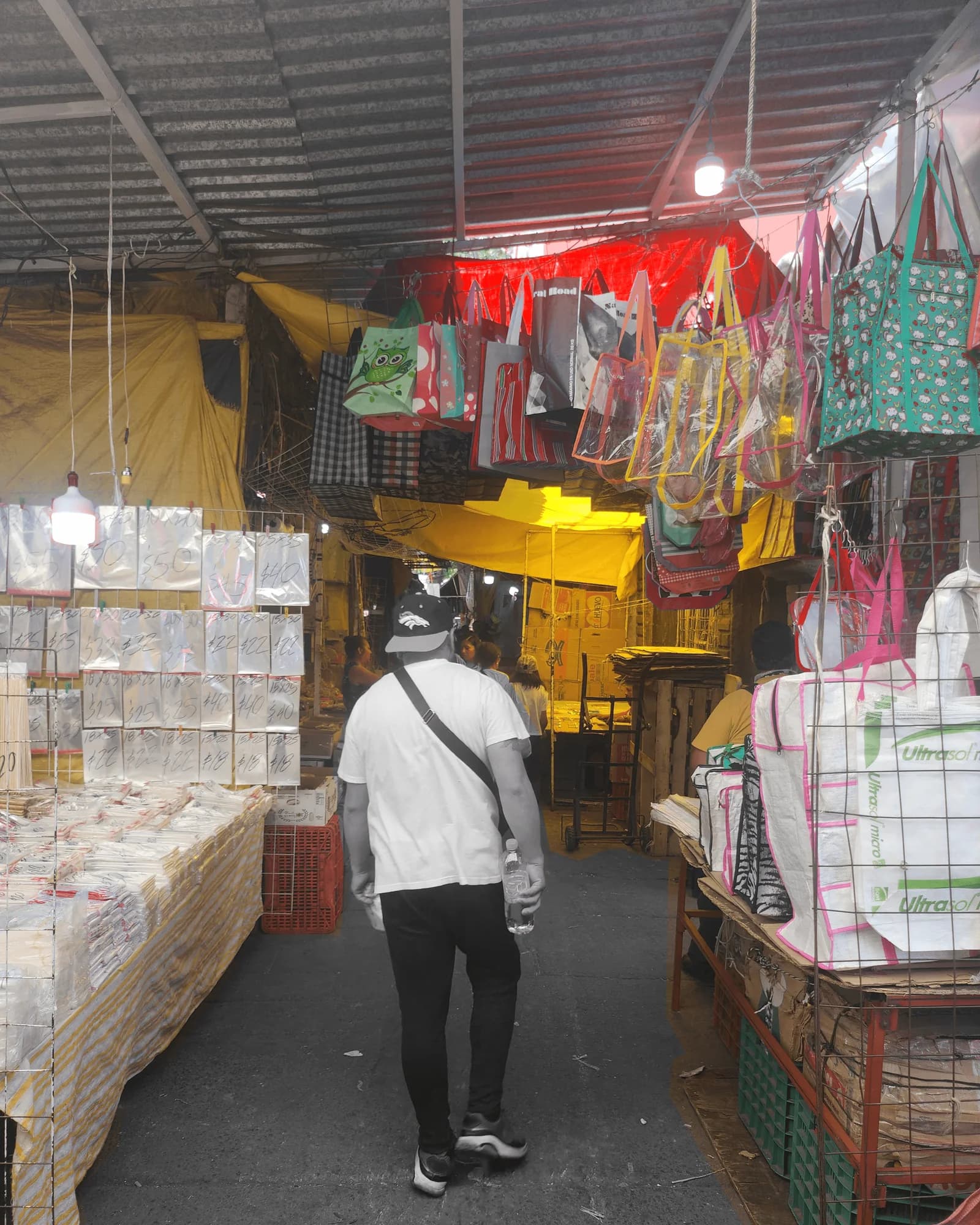
FIG. 14
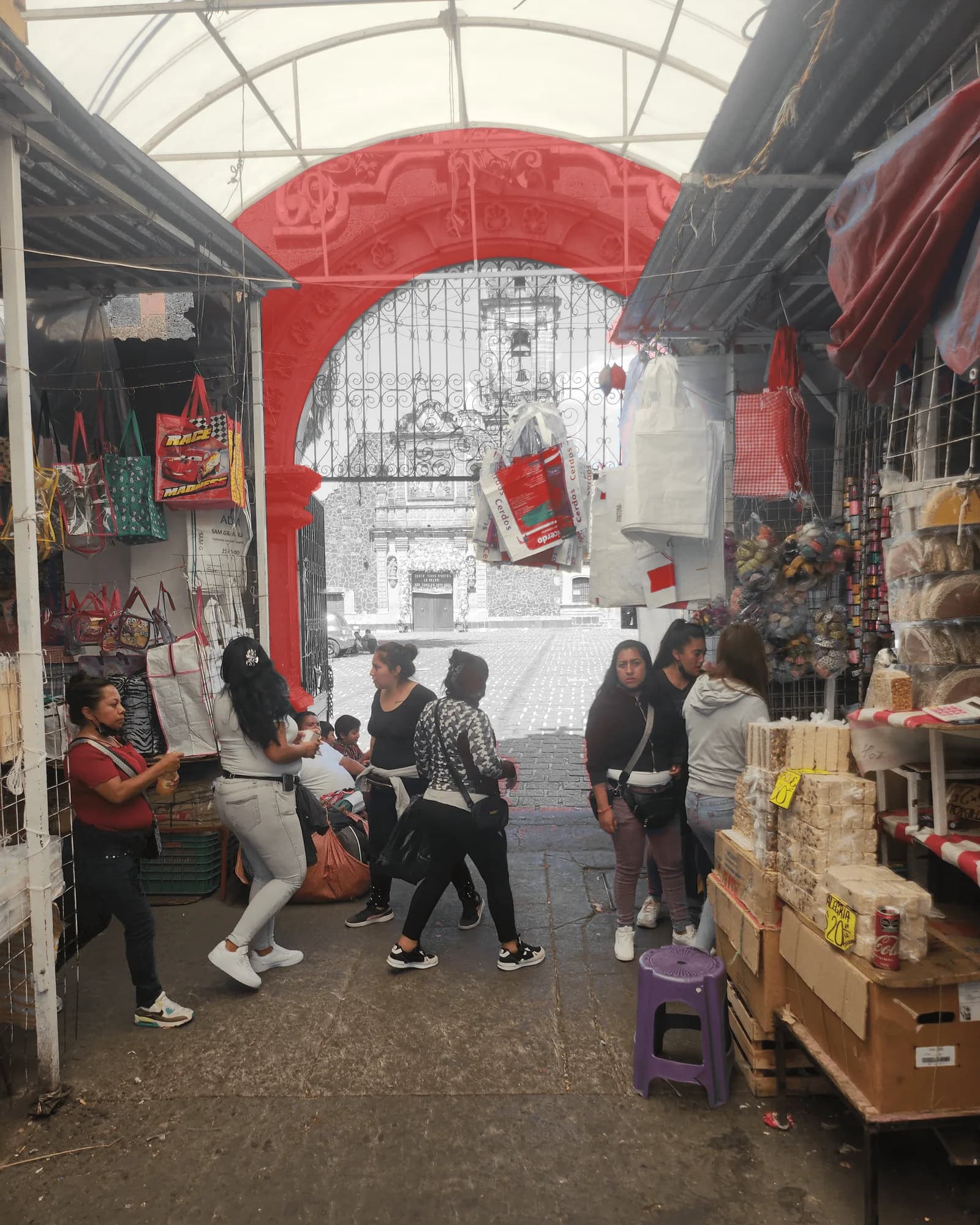
FIG. 12
7The polished surface that never arrives
In _The Salvation of the Beautiful_, Byung-Chul Han describes an age that confused beauty with polish: the smooth, clean, hygienic surface that offers no resistance. Under that definition, the stall is precisely the opposite of beautiful.
But consider what hangs from it. Every object aspires to polish. The pirated brands are smooth brands; the characters are made of bright plastic. The stall is not a rebellion against the polished surface. It is an attempt to reach it with whatever is available. It never arrives. Its whole aesthetic lives in that distance—between what the stall wants to resemble and what it is.
Timotheus Vermeulen and Robin van den Akker described metamodernism in 2010 as an oscillation between modern enthusiasm and postmodern irony, an informed naïveté. Jimenez Lai brought the discussion into architecture.
At La Palma the oscillation exists, but honesty requires locating it correctly. It is not in the merchant, who is working—and nothing is more sincere than that. It is in me. On one visit I see damage to heritage; on the next, the liveliest façade on Circunvalación. I stopped trying to settle the question.
Someone is selling in order to eat. Someone is driving a nail into an eighteenth-century wall. Both statements are true, and neither cancels the other. The difference is that statistics exist for the first, while nobody keeps count of the second.
8It is not an accident
A few blocks away stands Nuestra Señora de Loreto, another colonial church in Area B. There are no burladeros there, and the same thing happens. It seemed even more saturated: commerce uses the rear wall directly as a base and builds outward from it.
Loreto isolates the variable. The burladero does not cause appropriation; a wall is enough. What the burladero did was industrialize it, giving module, alignment, and repetition to something that had already been happening by hand.
Loreto adds an uncomfortable fact. The building is undergoing structural work while commerce continues unchanged. The institution reaches the stone and stops there.
FIG. 15
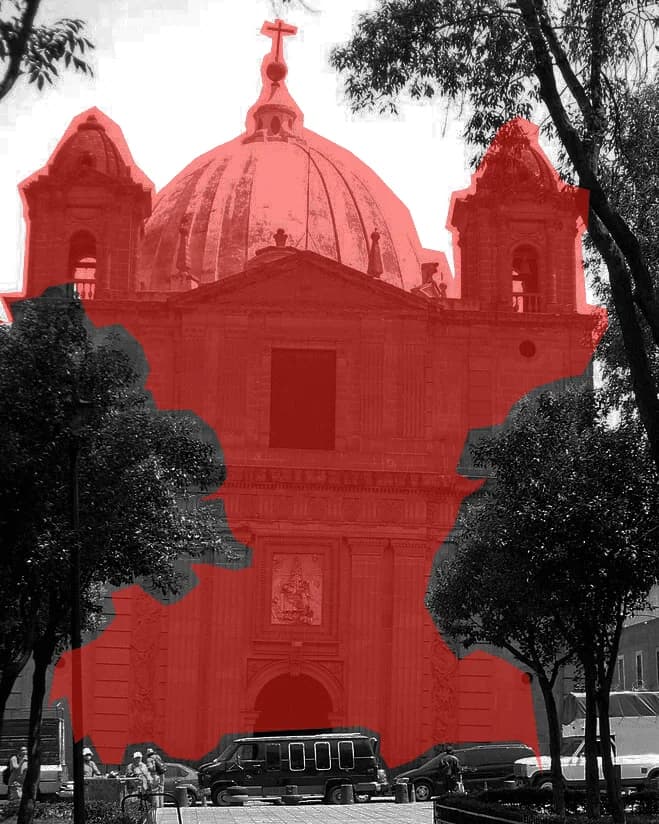
FIG. 16
9Coda
I am not proposing that the church be rescued or that anyone be removed. I am proposing a change in how we read it.
A city's architecture is not only what was designed and built. It is also what was later leaned against it, what happens in front of it, what covers it, and what uses it. On Circunvalación this second layer has more color, information, merchandise, and movement than the first. That is why it wins, every day, without a design meeting.
La Palma is not hidden. It is underneath. There is a difference: what is hidden can be discovered; what lies underneath has to be learned as a way of reading. The city wrote over the building, in a larger hand.
Now I always see it when I travel along Circunvalación. I also began to see the others: the metal shutter that swallowed a portal, the advertisement that became a parapet, the tarpaulin that now crowns a corner. That is the problem with giving something a name.
It cannot be unnamed.
FIG. 01